

There’s an uncomfortable truth that political elites and mainstream media would rather bury: Islamist extremism and its associated antisemitic violence are not confined to distant battlefields, they are spreading across Western societies—and every major incident is treated with euphemisms and excuses instead of honest naming and urgent action.
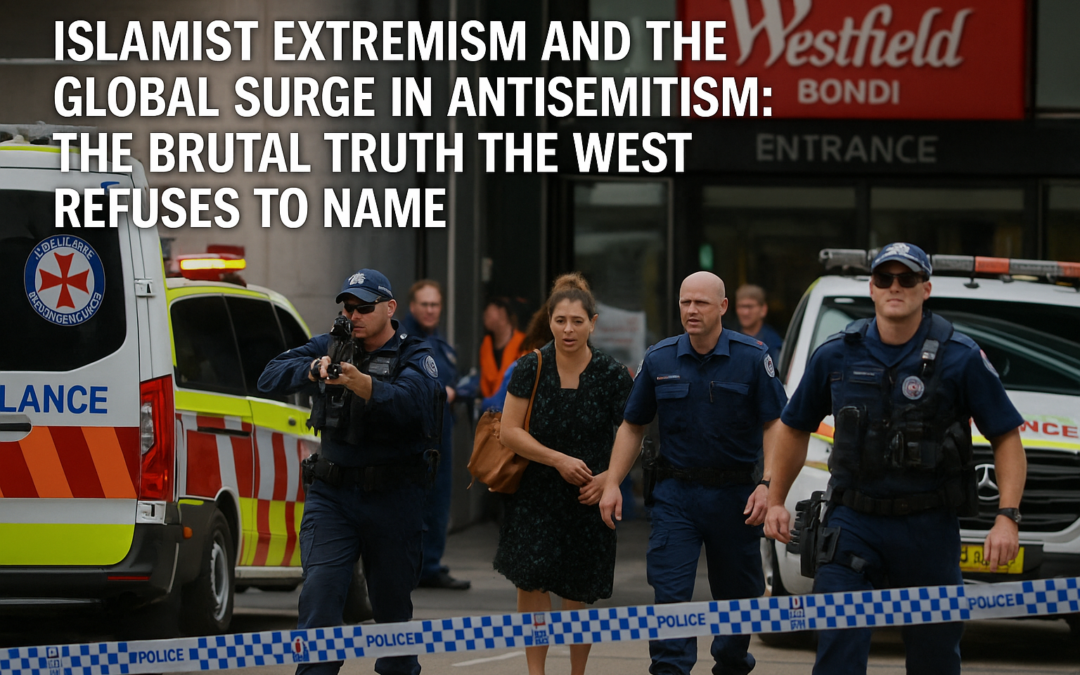
Let’s start with today’s news, because the illusion of safety is dying before our eyes. On December 14, 2025, during a Hanukkah celebration at Sydney’s famous Bondi Beach, two gunmen opened fire on a crowd of celebrants, killing at least 16 people, including a child, and injuring dozens more in what authorities immediately declared an antisemitic terrorist attack. Australian leaders called it a deliberate attack on Jews gathered for a religious festival. Explosive devices were even found near the scene.
This wasn’t a random act of violence. It was targeted, ideological, and murderous—a chilling escalation from rising antisemitic incidents across Australia over the last two years. Hate crimes such as synagogue firebombings, arson attacks, and vandalism surged sharply following the Gaza conflict in 2023.
That this massacre happened in a country once thought safe from such horror should be a wake-up call. But in the West, we rarely connect the dots between ideology, intolerance, and violence. Instead, we hear soothing phrases like “isolated incidents,” or “complex social problems.”
Let’s be clear: tolerance is not a suicide pact. Ignoring ideology that openly despises Jews and glorifies violence invites exactly this kind of catastrophe.
Europe’s Crisis: Paris Cancels New Year’s Eve Celebrations
Meanwhile, in France, authorities recently cancelled the traditional New Year’s Eve concert on the Champs-Élysées—an event that typically draws millions—not because of snow or infrastructure issues, but because of threats to public safety tied to extremist violence and migrant-associated unrest in Parisian suburbs. Critics point directly at rising violence linked to poorly integrated immigrant communities, especially in areas dominated by Islamist radicalization and socioeconomic alienation.
This is what happens when governments refuse to enforce assimilation and security. Streets once teeming with cheer now carry a heavy security presence; celebrations are replaced with pre-recorded broadcasts and ominous warnings from police urging citizens to stay home.
France’s Jewish community has felt this shift acutely for years. Antisemitic abuse and attacks surged long before 2025, with synagogues, Holocaust memorials, and Jewish businesses repeatedly targeted.
This isn’t hypothetical fear-mongering. It’s reality.
Terrorist Attacks Aren’t “Blips”—They’re a Trend
Across the West, incidents once thought impossible are becoming alarmingly routine:
-
In France, the Mulhouse stabbing attack in February 2025 saw a knife assault tied to militant Islamist extremism, killing a civilian and wounding officers. The perpetrator was a known extremist whom the state had tried—and failed—to deport.
-
In the UK, the Manchester synagogue attack in October 2025 involved a vehicle and knife assault on worshippers during Yom Kippur, killing three and injuring others in a brazen terror act targeting Jews.
These incidents aren’t isolated blips; they’re symptomatic of a wider pattern: violent ideology crossing borders and exploiting gaps in enforcement, assimilation, and public discourse.
Why Leaders Refuse to Face the Truth
What’s most disturbing is not the violence itself—terrible as it is—but how Western institutions react:
-
Politicians avoid naming Islamist extremism as a root cause.
-
Media treats antisemitism as a side effect of geopolitics rather than an ideological grievance worth confronting directly.
-
Law enforcement is reactive instead of preventative.
When a growing number of European mayors warned recently that antisemitism is at crisis levels, they were met with platitudes rather than decisive policy responses.
This silence and equivocation create an environment where extremists feel emboldened, and their violence metastasizes.
Not All Muslims Support Extremism—but Extremism Supports Violence
Let’s make this clear: criticizing Islamist extremism is not hatred against Muslims. It is confrontation with a political and religious ideology that explicitly uses religion as a vehicle for violence and antisemitism. Millions of Muslims reject violence and live peacefully. But the refusal to call out the radical elements—who use the same symbols and language as their peaceful co-religionists—is a strategic error with deadly consequences.
The events in Sydney, Paris, Manchester, Mulhouse, and other cities prove one thing: when extremist ideologies are left unchallenged, they breed violence. And when governments treat ideology as taboo, they cede public safety to those who don’t share Western values of pluralism and respect.
Conclusion: Western Societies Must Wake Up
We can no longer pretend that these incidents are anomalies. They are part of a global trend of ideological terrorism and antisemitic violence that respects no borders and targets innocent people during religious celebrations, public holidays, and national festivities.
Ignoring the phenomenon doesn’t make it go away. It empowers extremists and endangers Jews, Christians, secular citizens, and anyone who believes in open societies.
If Western leaders want to preserve civil order and protect all citizens, they must stop minimizing the problem, start naming the ideology fueling the violence, and begin policies that confront extremism at its roots. That is not prejudice—that is survival.